High-Throughput IHC Staining Automation for Confident Diagnostic Decisions
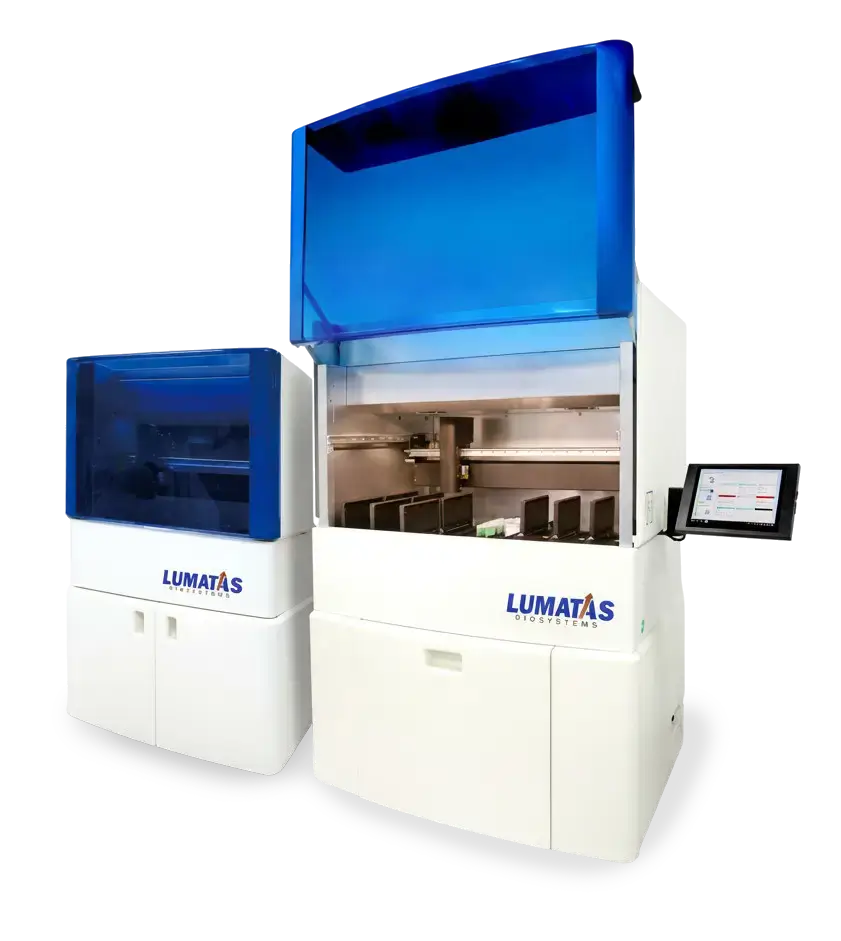
Titan® & Titan® S
Titan Automated IHC Systems deliver dependable staining quality at scale. Designed for high-throughput pathology workflows, Titan automates critical processing steps to increase daily slide capacity, reduce hands-on time, and provide reproducible results across routine and advanced IHC applications.
Why Laboratories Choose Titan
- Fully automated IHC workflow
- Intuitive software design
- Flexible protocol customization
- Double staining capability
- High-throughput processing
- Minimal daily maintenance
- Complete reagent and slide traceability
- Scalable platform options
Exceptional Staining Quality
Reliable, reproducible staining — at any workload
High-quality staining is the basis of every accurate diagnosis. Titan® combines fully automated processing with optimized ready-to-use reagents to deliver crisp, consistent results from deparaffinization through counterstaining.
- High-quality visualization of target biomarkers
- Reliable staining performance across routine and advanced IHC applications
- Reproducible results from run to run, independent of daily workload
- Broad portfolio of ready-to-use reagents optimized for Titan instruments
Staining Designed for Diagnostic Confidence
Standardized workflows in every slide
By reducing manual variability and ensuring consistent process control, Titan supports pathologists and laboratory teams in delivering dependable results—whether handling daily routine testing or increasing case volumes.
- Standardized, automated workflows reduce variation versus manual processing
- Built-in barcode traceability improves sample and process control
- Controlled reagent dispensing supports consistency and efficient reagent use
- Automated documentation and workflow transparency support quality assurance
Engineered for High Throughput
Scale staining capacity without compromising quality
Titan is designed for laboratories that need to process more slides with less hands-on time.
- Fully automated workflow, including deparaffinization, staining, counterstaining, and reagent tracking/management
- Reduced manual intervention enables staff to focus on higher-value laboratory activities
- Batch-based processing supports efficient handling of routine and peak workloads
- High daily slide capacity supports scalable operations and improved laboratory productivity
Flexible Automation for Your Workflow
High-throughput capability for laboratories' needs
Support routine IHC testing and double staining applications with customizable protocols designed to fit your workflow.
- IHC applications / Flexible pretreatment options
- Double staining capability / Open protocol customization
- HL7 and XML compatibility
- Network connectivity across multiple instruments
Built for Productivity
For routine volume today—and growth tomorrow
Titan systems are engineered to help laboratories manage increasing case volumes with maximum efficiency and minimal daily operator intervention.
- Titan S: 36-slide capacity / Up to 108 slides per day
- Titan: 72-slide capacity / Up to 216 slides per day
Designed to deliver high throughput while minimizing daily operator intervention.
Ideal for: Medium-volume pathology laboratories / High-volume hospital systems / Reference laboratories / Growing oncology testing programs
Backed by Global Support
- Worldwide service network
- Training and implementation assistance
- Responsive technical support
Technical Specifications
| Instrument type | Titan S | Titan |
|---|---|---|
| Applications | IHC, ICC, double staining, EBER, FISH | |
| Slide capacity | 36 | 72 |
| Reagents | 44 (15 mL vials) / 22 (30 mL vials) | 80 (15 mL vials) / 40 (30 mL vials) |
| Reagent pipetting volume | 100 to 300 µL | |
| Reagent volume | 15 mL primary antibodies / 30 mL reagents | |
| Pipetting needle | 4.8 mL | |
| Dewaxing volume per slide | 0.2 mL | |
| Waste management | Separation of hazardous substances and non-critical waste liquids | |
| Control | Each instrument is equipped with its own computer. Up to 4 instruments can be connected to a network, allowing easy viewing of the status of each instrument on the network. Slide and reagent labels can be entered and printed using any connected device. | |
| LIS compatibility | Compatible with HL7 and XML interface standard | |
| Volume of pretreatment buffers per module (regardless of how many slides are inserted into a module) | 150 mL | |
| Buffer volume per slide per run (PBS/Tween)-HRP/DAB | 104.5 mL | |
| Buffer volume per slide per run (PBS/Tween)-AP/Fast Red | 96 mL | |
| Dimensions | 97 cm (W) / 78 cm (D) / 175 cm (H) | 143 cm (W) / 86 cm (D) / 175 cm (H) |
| Weight | 200 kg | 400 kg |